Keeping an Eye on Domestic Violence
Domestic violence is a serious issue that deserves more attention than we give it. Domestic violence affects people of all ages, races, genders, and socioeconomic statuses and it happens every day. Yet, it seems as though the only times that domestic violence becomes a topic of conversation is when something horrible happens and we see stories of extreme violence, often involving death, on the news. In 2008, nine people were killed by intimate partners, or significant others. So far there have been three such killings this year.
The most recent of these stories in Hawai'i was the murder of 25 year-old Royal Kaukani on March 19. Kaukani was shot several times by her ex-boyfriend, Toi Albert Nofoa, while she was sitting in her vehicle near her home in Ewa. Kaukani had reported being abused by Nofoa several times throughout their relationship and had filed for restraining orders twice before. She first reported abuse to police in 2006 when Nofoa threw her down a flight of stairs. Nofoa had even allegedly kidnapped Kaukani at gunpoint on September 15, 2008. She was able to escape with the help of a gas station worker in Hale'iwa. (More details on this case can be found here)
As sad and shocking as this story may seem, others like it occur all too often. We just don't hear about them. But it is important that we, as a society, become more aware of the prevalence of domestic violence so that we can find ways to reduce its incidence and so that victims of domestic violence feel more comfortable seeking help. One of the common beliefs held by victims of domestic violence is that they are alone. Frequently this happens because abusers make their victims feel alone and often isolate their victims from friends and family that might convince them otherwise. If we made it a conscious effort to keep public attention on this issue, it would be easier for victims to see that they are not alone, that there are many other victims out there, and that people really care about what they are going through.
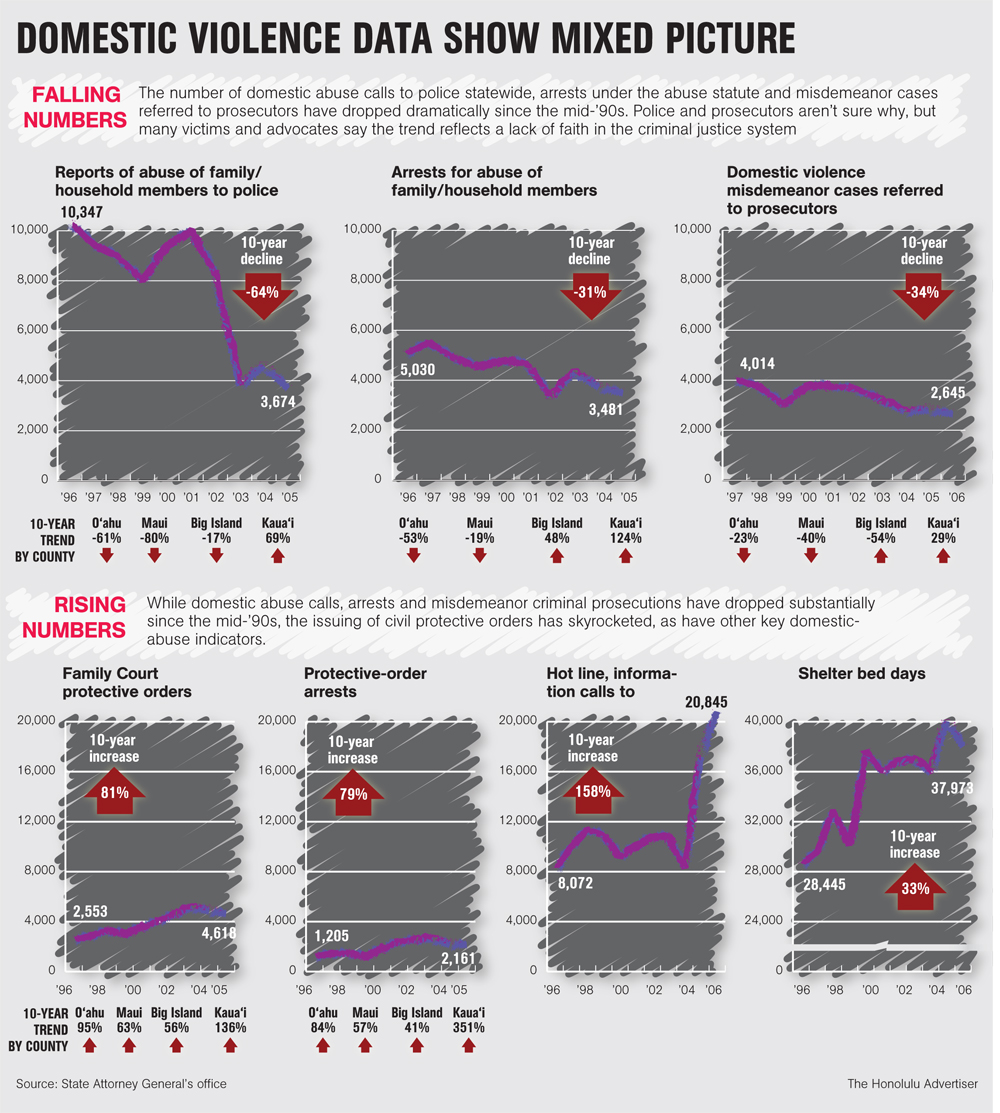
At the same time, increased public awareness may also lead to an increase in reports of domestic violence. Domestic violence and intimate partner violence statistics are often hard to obtain and may be misleading because victims tend to be reluctant to speak out. For example, according to U.S. Department of Justice, intimate partner violence decreased between the mid 1990s and the mid 2000s. Some of the State Attorney General's office statistics seem to correspond with this decrease. For example, the number of police reports of domestic violence, arrests, and domestic violence related misdemeanor cases decreased between these years as well. This makes it seem like the incidence of domestic violence has been decreasing. However, according to the State Attorney General's office, the number of protective court orders, hotline calls, and abuse shelter bed use increased. These statistics seem to contradict the others. Why the discrepancy?
One reason is because victims tend to view the judicial system as "broken". Rob Perez discusses this sentiment in an online article for the Honolulu Advertiser called "System Failure". Overall, the judicial system can be very frustrating and unrewarding for victims of domestic violence. This reputation discourages victims from seeking help through legal means. However, it is important that victims know that the police and the judicial system are important resources and should not be discounted. Keeping a documented record of police reports can be very helpful in court cases. It helps to establish a history of violence and to draw attention to the problem.
The biggest reason why victims of domestic violence don't report incidents of abuse is fear. Abusers use fear to control their victims and to scare them from going to the police or from leaving the relationship. Sometimes people have a hard time understanding why victims of domestic violence don't just leave or why they keep going back to their abusers. This is a complicated issue. Victims are afraid that if they leave or report, their abusers will hurt them even more. They may also be afraid that their abusers will hurt people they care about. Victims may also think that abusers will change and things will get better. Another reason is because many victims also tend to blame themselves for the abuse they receive. This is sometimes referred to as the "battered wife syndrome". Victims can feel guilty and believe they brought on their attacks. It is important for victims of domestic violence to know and understand that abuse of any kind is never acceptable and is never their fault. There is never an excuse for domestic violence. Never.
Domestic violence has many signs and recognizing them is the first step in helping someone escape a really bad situation. The most obvious sign is bruises or other injuries but physical abuse is only one part of a domestic violence relationship. Another sign is verbal abuse. Abusers constantly belittle their victims to destroy their confidence, hurt them, and keep them from leaving. Abusers also threaten their victims to instill fear. They may threaten to hurt or kill their intimate partners, their family members, and even threaten to hurt or kill themselves. Another sign of an abusive relationship is extreme jealousy and control. Abusers tend to be very jealous and sometimes accuse their victims of cheating. They also demand that their victims spend almost all their time with them. Abusers get jealous of other people spending time with their victims and become very controlling over what their victims do and when they do anything. They also control who their victims talk to and may sometimes seem overly attentive. Another sign of domestic violence is that the victims become very quiet, timid, and withdrawn. Victims may also mention their abusers' mood swings or bad tempers. These are all red flags. If any of these signs applies to yourself or someone you know, seek help.
There are many resources and sources of help for domestic violence victims. On every page of the Hawaii State Coalition Against Domestic Violence (HSCADV) website there is a list of phone numbers for domestic violence victims to call for help. The first is 911. As already discussed, calling the police and filing reports of violence helps victims prove abuse if or when they decide to press charges against their abusers or apply for restraining orders. The other phone numbers are for 24-hour hotlines for each island. For the island of O'ahu, victims should call 841-0822 if they are in town or on the leeward side and 526-2200 if they are on the windward side. The Honolulu Advertiser website provides a fairly comprehensive list of resources here. This list includes the phone numbers to shelters and organizations like Legal Aid Society of Hawai'i and PACT Family Peace Center among others. The University of Hawaii also provides counseling and services for its students. If you feel like you may be in an abusive relationship or believe you know someone who is and would like more information on how to seek help, visit the Women's Center in QLCSS 211 or call at 956-8059.
C, Rainbow Connection Staff Writer